OSHA 10 vs OSHA 30, and the Other Construction Certifications Recruiters Should Know
A plain-English cheat sheet for reading the credentials section of a construction resume: what each card or certification means, who should have it, and how to check it.
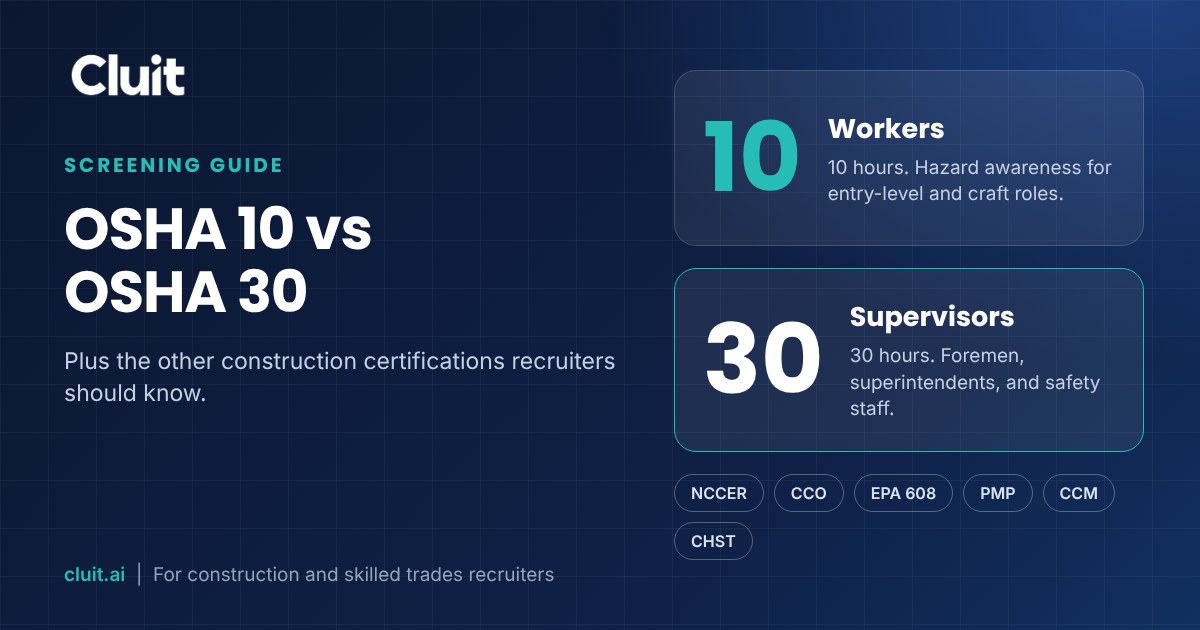
OSHA 10 is a 10-hour safety awareness course for entry-level workers. OSHA 30 is a 30-hour course for supervisors and anyone with safety responsibility, such as foremen, superintendents, and safety staff. Neither card expires under federal rules, but some states, cities, and project owners require one issued within the last five years.
Key takeaways
- OSHA 10 is for workers. OSHA 30 is for supervisors. On a superintendent or foreman resume, expect OSHA 30.
- Federal OSHA treats both courses as voluntary and puts no expiration date on the cards. State, city, and owner rules can be stricter.
- There is no public national database of OSHA cards. Verify through the trainer or training organization that issued it.
- Look for the Construction version of the card. General Industry and Maritime cards are different courses.
- Beyond OSHA, the credentials that come up most are NCCER, CCO crane certification, EPA 608, state trade licenses, PMP, CCM, and CHST or CSP.
What is the difference between OSHA 10 and OSHA 30?
Both come from OSHA's Outreach Training Program. The difference is depth and audience. The 10-hour course teaches workers to recognize and avoid common jobsite hazards. The 30-hour course covers the same ground in more detail and adds the responsibilities of people who direct other workers.
| OSHA 10 | OSHA 30 | |
|---|---|---|
| Length | 10 hours | 30 hours |
| Built for | Entry-level and general workers | Supervisors, foremen, superintendents, safety staff |
| Depth | Hazard awareness basics | Broader and deeper, with supervisory responsibility |
| What the worker receives | Department of Labor course completion card | Department of Labor course completion card |
| Federal expiration | None | None |
| Typical on a resume for | Laborers, helpers, apprentices, journeymen | Foremen, superintendents, project managers, safety managers |
Two details trip up new recruiters:
- There are separate versions by industry. Construction, General Industry, and Maritime are different courses with different cards. For a construction role, the card should say Construction.
- It is a completion card, not a certification. OSHA does not certify workers. The card shows the person finished a course taught by an OSHA-authorized trainer. Candidates often write "OSHA 30 certified" anyway, and that is fine to accept as shorthand.
Do OSHA 10 and OSHA 30 cards expire?
Not under federal rules. OSHA does not put an expiration date on Outreach cards, and OSHA itself describes the 10-hour and 30-hour courses as voluntary.
In practice, "does it expire" depends on where the work is and who owns the project:
- Some states and cities require a card issued within a set window, commonly five years, for certain work such as public projects.
- New York City Site Safety Training (SST) cards, which build on OSHA training, expire five years after they are issued.
- Many general contractors, owners, and unions set their own recency rules, often three to five years.
- Replacement cards can generally only be issued within five years of the original course, so a candidate who lost an old card may need to retake it.
The safe habit is to capture the completion date for every card and put it in the submittal. It saves a round trip with the client.
Which states require OSHA 10 or OSHA 30?
Several states have laws requiring OSHA 10, and in some cases OSHA 30 for supervisors, on specific kinds of construction work. These rules most often apply to public works projects. States commonly cited as having requirements include Connecticut, Massachusetts, Missouri, Nevada, New Hampshire, New York, Rhode Island, and West Virginia, and some cities such as New York City and Philadelphia add their own.
Requirements change and vary by project type and contract value. Treat this list as a prompt to check, not as legal advice. Confirm the current rule with the state labor department or the project owner before you submit a candidate.
How do you verify an OSHA 10 or OSHA 30 card?
There is no public, national lookup for OSHA Outreach cards. To check one:
- Ask for a photo of both sides of the card. Confirm the name, the course (Construction 10 or 30), and the issue date.
- Scan the QR code if the card has one. Many newer cards include a code that links to a verification page from the issuing organization.
- Contact the trainer or training provider. The authorizing training organization named on the card keeps the records and can confirm completion.
- Keep a copy in the candidate file. Clients on public work may ask for it during onboarding.
What other construction certifications should recruiters recognize?
These are the credentials that show up most on construction and skilled trades resumes. Renewal cycles are the standard ones published by each issuing body, so confirm current rules for anything a placement depends on.
| Credential | Issued by | What it tells you | Typical renewal |
|---|---|---|---|
| NCCER craft credentials | NCCER | Completed standardized craft training or assessments in a trade. Recorded in the NCCER Registry, which employers can check. | Training credentials do not expire |
| CCO crane operator certification (formerly NCCCO) | CCO | Certified to operate specific crane types. Federal OSHA rules require crane operators in construction to be certified or licensed. | 5 years |
| EPA Section 608 | EPA-approved programs | Legally allowed to handle refrigerants. Essential for HVAC technicians. | Does not expire |
| Journeyman or master license | State or local licensing board | Licensed to work in a trade such as electrical or plumbing. Rules differ by state and do not always transfer. | Varies by state |
| AWS Certified Welder | American Welding Society | Passed a performance test for a specific welding process and position. | Maintained every 6 months |
| CHST and CSP | Board of Certified Safety Professionals | Professional safety credentials. CHST is construction-specific. CSP is the senior credential. | 5-year cycle |
| PMP | Project Management Institute | General project management certification. Common for project managers at larger firms. | 3 years |
| CCM | Construction Management Association of America | Certified Construction Manager. Signals senior, construction-specific management experience. | 3 years |
| LEED AP | Green Business Certification Inc. | Knowledge of green building standards. Relevant on LEED projects. | 2 years |
| HAZWOPER 40 | OSHA-compliant trainers | Trained for hazardous waste site work. | 8-hour refresher every year |
| First Aid and CPR | Red Cross, American Heart Association, and others | Often required for foremen and superintendents. | 2 years |
| TWIC card | Transportation Security Administration | Cleared for unescorted access to ports and maritime facilities. Common on Gulf Coast industrial work. | 5 years |
Which certifications should you expect by role?
- Laborer, helper, apprentice: OSHA 10. NCCER Core is a plus.
- Journeyman tradesperson: OSHA 10, the relevant state license, and trade credentials such as NCCER, EPA 608, or AWS.
- Foreman: OSHA 30, First Aid and CPR, and the trade license.
- Superintendent: OSHA 30, First Aid and CPR. Some owners ask for additional site-specific training.
- Safety manager: OSHA 30 at minimum. CHST or CSP for mid-level and senior roles. Some are OSHA-authorized outreach trainers.
- Project manager: OSHA 30 is common. PMP or CCM at larger general contractors.
- Crane operator: CCO certification for the specific crane type.
Titles mean different things at different companies. If you need a refresher on who does what, see our guide to construction job titles and hierarchy.
What are the red flags in a resume's certifications section?
- No dates. Ask for the completion or expiration date on every credential.
- The wrong version. An OSHA 10 General Industry card is not the Construction card.
- A license from another state. Trade licenses do not automatically transfer. Check reciprocity before you pitch a relocation.
- Expired time-limited credentials. CCO, PMP, CCM, and First Aid all lapse.
- Vague wording. "Safety certified" or "crane certified" with no issuing body needs a follow-up question.
Once you have confirmed the details, put them where the client will see them first. A clean credentials block near the top of the submittal answers the hiring manager's first screening question before they ask it. Here is how to structure a candidate submittal.
Frequently asked questions
Does OSHA 10 expire?
Not under federal rules. OSHA does not put an expiration date on 10-hour or 30-hour Outreach cards. Some states, cities, unions, and project owners require a card issued within a set period, often five years.
Is OSHA 30 better than OSHA 10?
OSHA 30 is more in-depth and is designed for supervisors, while OSHA 10 is designed for entry-level workers. Most employers accept a 30-hour card where a 10-hour card is required, but confirm for jurisdiction-specific rules.
Is OSHA 10 required by law?
Federal OSHA says the 10-hour and 30-hour courses are voluntary. Several states and cities require them for certain construction work, usually public projects, and many employers require them as a condition of hire.
How can I verify an OSHA card?
There is no public national database. Ask for a photo of the card, scan the QR code if it has one, and contact the trainer or training organization that issued it to confirm completion.
What is NCCER certification?
NCCER is a nonprofit that publishes standardized construction craft training and assessments. Completed credentials are recorded in the NCCER Registry, where employers can confirm them.
What certifications does a construction superintendent need?
Most employers expect OSHA 30 and current First Aid and CPR. Depending on the project, owners may also ask for site-specific safety training. There is no single required license for superintendents in most states.
Sources
Figures were checked against these sources on November 12, 2026.
- OSHA, Frequently Asked Questions: Does OSHA require the 10- and 30-hour outreach courses?. Link
- Lancaster Safety, "States with 10/30 Hour OSHA Outreach Training Requirements". Link
- 360training, "Does OSHA 30 Expire? How Long OSHA 30 Is Good For," August 20, 2026. Link
- Hard Hat Training, "Does OSHA 10 Expire? What Workers Should Know". Link
- J. J. Keller and HSI, OSHA 10 and 30 Hour Support FAQs (PDF). Link
Put credentials where clients look first
Cluit pulls licenses and certifications out of a messy resume and formats them into a clean, submittal-ready candidate pack in minutes.