Construction Job Titles Explained: The Jobsite Hierarchy From Laborer to Project Executive
Who reports to whom, what each role actually does, and how to tell a superintendent from a project manager when two companies use the same title for different jobs.
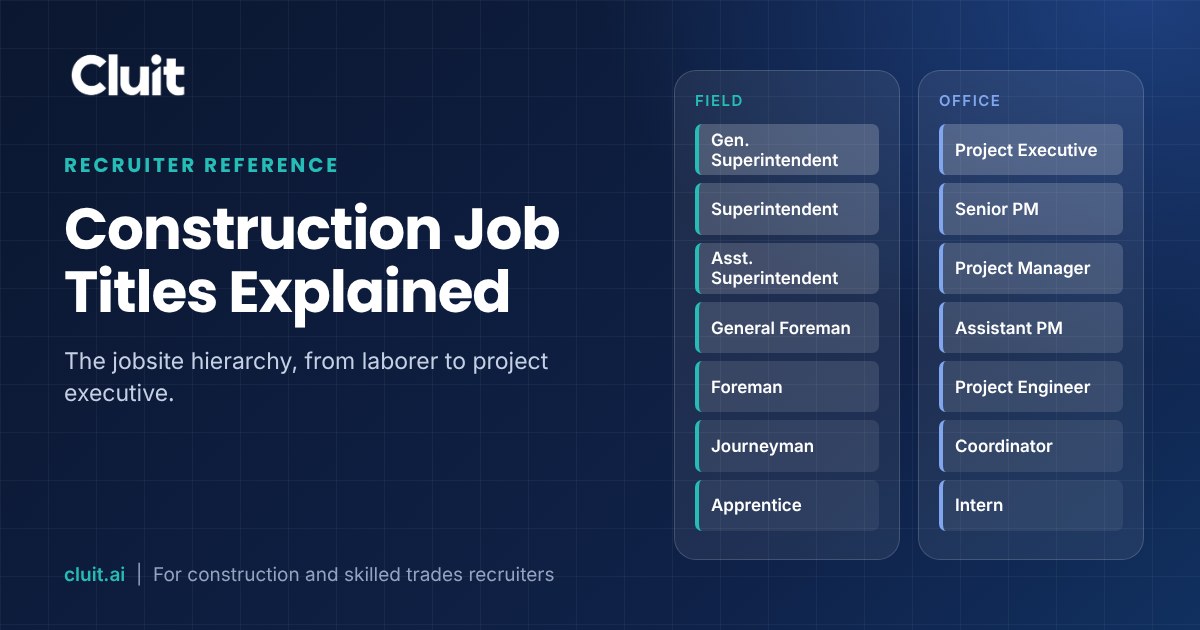
Construction roles run on two parallel ladders. The field side builds the work: laborer, apprentice, journeyman, foreman, general foreman, superintendent. The office side manages cost, contracts, and schedule: project engineer, assistant project manager, project manager, senior project manager, project executive. The superintendent runs the jobsite. The project manager runs the budget and the contract.
Key takeaways
- Field roles own safety, quality, and daily production. Office roles own budget, contracts, and client communication.
- A superintendent and a project manager are peers on most projects, not boss and subordinate.
- A project engineer in construction is usually an entry-level management role, not a licensed engineer.
- The same title can mean very different things at a general contractor, a subcontractor, and a homebuilder.
- Screen on project type, project value, and scope of responsibility. Titles alone will mislead you.
How is a construction project team organized?
Almost every commercial project splits responsibility between the people who build it and the people who manage the money and paperwork. Both sides report up to a project executive or operations leader.
Field ladder
- General SuperintendentOversees several projects and superintendents
- SuperintendentRuns the jobsite day to day
- Assistant SuperintendentSupports the super, often owns one area or trade
- General ForemanLeads several crews in one trade
- ForemanLeads one crew
- JourneymanFully qualified tradesperson
- ApprenticeIn formal training for a trade
- Laborer or HelperGeneral and entry-level work
Office ladder
- Project ExecutiveOwns client relationship and portfolio results
- Senior Project ManagerRuns large or multiple projects
- Project ManagerOwns budget, contract, and schedule
- Assistant Project ManagerRuns parts of the project under the PM
- Project EngineerHandles RFIs, submittals, and documents
- Project Coordinator or InternAdministrative and document support
What do the field titles mean?
| Title | What they do | What to look for on a resume |
|---|---|---|
| Laborer or Helper | Site prep, cleanup, material handling, assisting trades. | Reliability, OSHA 10, equipment experience. |
| Apprentice | Learns a trade through paid work plus classroom hours, usually over four to five years for licensed trades. | Program name, year of apprenticeship, hours completed. |
| Journeyman | Works independently in a trade such as electrical, plumbing, pipefitting, or carpentry. | State license number, trade specialties, project types. |
| Foreman | Leads a crew, assigns daily tasks, tracks production, enforces safety. | Crew size, OSHA 30, type of work self-performed. |
| General Foreman | Coordinates several foremen and crews within one trade on a large project. | Number of crews, peak headcount. |
| Assistant Superintendent | Manages a portion of the site, such as interiors or sitework, and covers for the superintendent. | Scope owned, subcontractors managed. |
| Superintendent | Top authority on the jobsite. Owns the daily schedule, subcontractor coordination, safety, and quality. | Project value, building type, ground-up vs renovation, schedule results. |
| General Superintendent | Supervises superintendents across multiple projects and sets field standards. | Number of projects and supers overseen. |
What do the office and project management titles mean?
| Title | What they do | What to look for on a resume |
|---|---|---|
| Project Coordinator | Document control, meeting minutes, closeout paperwork. | Software used, such as Procore, and volume of documents handled. |
| Project Engineer | Processes RFIs and submittals, maintains drawings, supports the PM and superintendent. Usually an early-career role. | Degree, project types, software, progression toward APM. |
| Assistant Project Manager | Manages change orders, subcontractor buyout, and parts of the budget. | Dollar value of scopes managed. |
| Project Manager | Accountable for cost, contract, schedule, and the owner relationship. | Project value, delivery method, fee or margin results, client types. |
| Senior Project Manager | Runs the largest projects or several at once and mentors PMs. | Largest single project, total annual volume. |
| Project Executive | Oversees a portfolio, wins repeat work, and is the escalation point for the owner. | Portfolio size, client relationships, business development. |
What about preconstruction, safety, and support roles?
- Estimator: Prices the work from drawings and subcontractor bids. Senior estimators and chief estimators lead bid strategy.
- Preconstruction Manager: Leads budgeting, constructability review, and planning before construction starts, often working directly with the owner and architect.
- Scheduler: Builds and maintains the project schedule, commonly in Primavera P6 or Microsoft Project.
- Safety Manager or Safety Director: Runs the safety program, site audits, training, and incident response.
- Quality Control Manager: Verifies that work meets plans and specifications. Required by contract on many federal projects.
- MEP Coordinator or MEP Superintendent: Coordinates mechanical, electrical, and plumbing work. In high demand on data center and hospital projects.
- BIM or VDC Manager: Manages 3D models and clash detection.
Each of these roles has credentials that go with it. Our guide to OSHA 10, OSHA 30, and other construction certifications shows which ones to expect.
Which construction titles get confused most often?
Superintendent vs project manager
The superintendent is on site every day directing the work: sequencing trades, running safety, solving field problems. The project manager handles the business side: budget, contract, change orders, billing, and the owner. On most projects they are partners with separate reporting lines. A great superintendent is not automatically a fit for a PM opening, and the reverse is also true.
Foreman vs superintendent
A foreman leads one crew in one trade and usually still works with tools. A superintendent manages the whole site and all the subcontractors on it, and does not perform trade work.
Project engineer vs project manager
In construction, "project engineer" is typically the first rung of the management ladder. It rarely requires a Professional Engineer license. A project engineer supports the project manager. They are several years apart in responsibility.
Estimator vs preconstruction manager
An estimator produces the numbers. A preconstruction manager leads the whole pre-build phase, including client meetings, design feedback, and schedule. Some firms use the titles interchangeably, so ask.
Apprentice vs journeyman vs master
An apprentice is in training. A journeyman has completed training and, in licensed trades, passed the state exam. A master has additional experience and a higher license that usually allows pulling permits and supervising others. Requirements are set state by state.
Construction manager vs general contractor
These are company roles as much as job titles. A general contractor holds the contract to build the project. A construction manager may act as the owner's advisor, or may hold the contract at risk. A candidate from an owner's rep firm has managed builders, not necessarily built.
Why does the same title mean different things at different companies?
- General contractor vs subcontractor. A project manager at an electrical subcontractor manages one trade's scope. A project manager at a general contractor manages all of them. Both are real PM experience, but they are not interchangeable.
- Company size. A senior project manager at a small firm might run $5 million jobs. At a national contractor, an assistant project manager might own a $20 million scope.
- Sector. Residential, commercial, industrial, and heavy civil use overlapping titles for very different work. A homebuilding superintendent may run many houses at once. A commercial superintendent runs one large site.
- Self-perform vs managed work. Some contractors build with their own crews. Others manage subcontractors only. The daily job of a superintendent is different in each.
What should recruiters ask to see past the title?
- What was the contract value and type of your last three projects?
- Was your employer the general contractor, a subcontractor, or the owner's representative?
- Who did you report to, and who reported to you?
- Was the work ground-up, renovation, or tenant improvement?
- What delivery method was used, such as design-bid-build, design-build, or CM at risk?
- Did you own the budget, the schedule, or both?
- Which software did you use daily?
The answers belong in your submittal, because they are exactly what the hiring manager will ask. A short project history table does more than any title. See how to present a candidate to a client for a format that works.
Understanding titles also helps you read the market. Demand for experienced supervisors and licensed trades is high right now. The numbers are in our 2026 construction labor shortage statistics.
Frequently asked questions
What is the hierarchy of construction job titles?
On the field side, the usual order from entry level up is laborer, apprentice, journeyman, foreman, general foreman, assistant superintendent, superintendent, and general superintendent. On the office side it is project coordinator, project engineer, assistant project manager, project manager, senior project manager, and project executive.
Is a superintendent higher than a project manager?
Usually neither is higher. On most commercial projects the superintendent and project manager are peers. The superintendent runs the jobsite and the project manager runs the budget and contract, and both report to a project executive or operations manager.
What is the difference between a foreman and a superintendent?
A foreman leads a single crew in one trade and often still works with tools. A superintendent is responsible for the entire jobsite, including all subcontractors, the daily schedule, safety, and quality.
Is a project engineer a real engineer?
In construction, a project engineer is usually an entry-level project management role that handles RFIs, submittals, and documents. It typically does not require a Professional Engineer license.
What does a construction superintendent do?
A superintendent manages daily jobsite operations. That includes sequencing and coordinating subcontractors, maintaining the short-term schedule, enforcing safety, inspecting quality, and communicating with the project manager and owner.
What is the highest position on a construction site?
The superintendent is normally the highest authority physically on site. Above the site level, a general superintendent or project executive oversees multiple projects.
Sources
Figures were checked against these sources on November 12, 2026.
Show the experience behind the title
Cluit reformats any resume into a clean candidate pack that puts project history, scope, and credentials up front, ready to send to your client in minutes.