Construction Labor Shortage Statistics for 2026
Every number recruiters, staffing firms, and contractors keep getting asked for, pulled from ABC, AGC, NCCER, and the Bureau of Labor Statistics, with a link to each source.
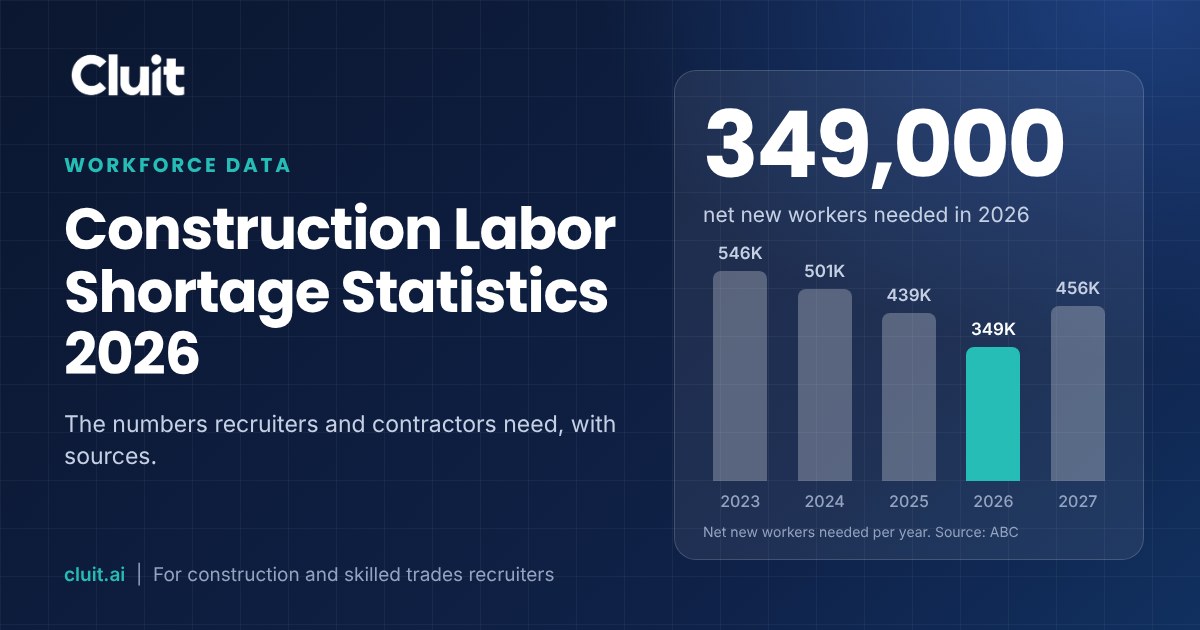
The U.S. construction industry needs about 349,000 net new workers in 2026 and 456,000 in 2027, according to Associated Builders and Contractors. In the 2026 AGC and NCCER workforce survey, 87% of contractors had open hourly craft positions, and 88% of those firms said the jobs were as hard or harder to fill than a year earlier. Electricians are the hardest trade to hire.
Key takeaways
- ABC estimates the industry must add 349,000 net new workers in 2026 and 456,000 in 2027. Most of the 2026 need comes from retirements, not growth.
- 87% of contractors report open craft positions and 82% report open salaried positions (AGC and NCCER, 2026).
- Construction had 298,000 job openings in September 2026, and construction unemployment hit a record low of 3.1% in August 2026.
- Electricians, HVAC technicians, pipefitters, and welders are the hardest roles to fill.
- 42% of contractors say worker shortages delayed a project, the most common cause of delay.
How many construction workers are needed in 2026?
Associated Builders and Contractors (ABC) publishes the most widely cited estimate each January. Its 2026 model says the industry needs to attract roughly 349,000 net new workers this year just to keep labor supply and demand in balance. That figure climbs to 456,000 in 2027, when construction spending is forecast to start growing again.
The 2026 number is lower than in recent years. That is not because the shortage is solved. ABC ties the drop to very modest spending growth forecasts, and says most of this year's demand comes from experienced workers retiring. ABC's model converts every $1 billion in added construction spending into about 3,450 new jobs, so any upside surprise in spending pushes the gap wider.
| Year | Net new workers needed | Change from prior year |
|---|---|---|
| 2023 | 546,000 | |
| 2024 | 501,000 | Down 45,000 |
| 2025 | 439,000 | Down 62,000 |
| 2026 | 349,000 | Down 90,000 |
| 2027 (projected) | 456,000 | Up 107,000 |
How hard is it to hire construction workers right now?
The Associated General Contractors of America (AGC) and NCCER surveyed 1,830 people at construction firms between July 8 and August 14, 2026. The results, released September 3, 2026, show that hiring stayed difficult even as parts of the market softened.
- 87% of respondents had open hourly craft positions.
- 82% had open salaried positions.
- Among firms with craft openings, 88% said those jobs were as hard or harder to fill than a year ago. Half said harder.
- Among firms with salaried openings, 87% said the same, and 41% said harder.
- 73% expect to add employees in the next 12 months. Only 8% expect to cut headcount.
- 42% said new hires fail to show up or quit shortly after starting.
- 42% said shortages of their own or their subcontractors' workers delayed a project, the most commonly cited cause of delay.
How many construction jobs are open?
The Bureau of Labor Statistics counted 298,000 open construction jobs at the end of September 2026, up from 262,000 in August. The job openings rate rose to 3.4%, compared with 2.4% a year earlier.
At the same time, almost nobody with construction experience is sitting on the bench. Construction unemployment fell to 3.1% in August 2026, the lowest rate for any month in the 26-year history of the data, according to AGC. Total construction employment reached 8,364,000 in September 2026, up 109,000 (1.3%) from a year earlier.
For a recruiter, those two numbers together explain the market. There are plenty of openings and very few unemployed candidates, so most placements come from people who already have a job.
Which construction trades are hardest to hire?
AGC's director of market insights said contractors find electricians the hardest occupation to hire, followed by HVAC technicians, pipefitters, and welders. Electrical apprenticeships run four to five years, so the supply of licensed electricians cannot expand inside a single project schedule.
Data center construction is making it worse. AGC's 2026 survey found that demand for workers on data center projects is contributing to shortages well beyond the jobsites themselves, because those projects pull electricians, mechanical trades, and experienced supervisors out of regional labor pools.
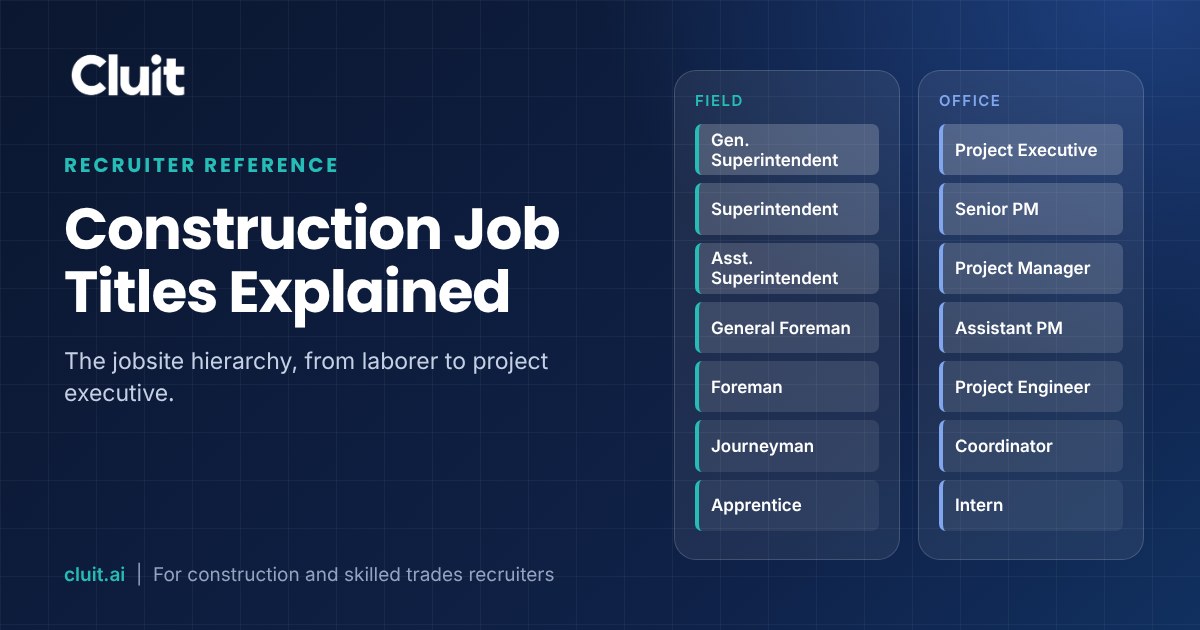
The shortage is not limited to craft labor. The 82% of firms with open salaried positions are looking for people in roles such as project manager, superintendent, and estimator. If the differences between those roles are fuzzy, our guide to construction job titles and hierarchy breaks them down.
What is causing the construction labor shortage?
- Retirements. ABC says a majority of new worker demand in 2026 is attributable to retirement instead of increased demand for construction services.
- Data center and manufacturing megaprojects. Large projects concentrate demand for the same scarce trades in a handful of regions.
- Immigration enforcement. About 29% of AGC respondents reported at least one direct or indirect impact from immigration enforcement in the prior six months. ABC's chief economist called immigration policy a potential wildcard for the labor force.
- Retention. With 42% of firms reporting no-shows or quick quits, part of the shortage is a churn problem, not only a pipeline problem.
- Long training timelines. Licensed trades take years to develop, so today's gap reflects apprenticeships that did not start four or five years ago.
What do in-demand construction roles pay?
National medians from the Bureau of Labor Statistics give a baseline. Local pay, overtime, and per diem on large projects can run well above these figures.
| Occupation | Median annual pay | Projected growth | Openings per year |
|---|---|---|---|
| Construction managers | $106,980 (May 2024) | 9% | About 46,800 |
| Electricians | $63,190 (May 2025) | 9% | About 81,000 |
| Construction laborers and helpers | $46,050 (May 2024) | 7% | |
| All construction and extraction occupations | $58,360 (May 2024) |
For comparison, the median for all U.S. occupations was $49,500 in May 2024.
What the shortage means for construction recruiters
The data points to a few practical conclusions for anyone placing construction talent in 2026.
- Passive candidates are the market. At 3.1% unemployment, the superintendent your client wants is working. Sourcing and relationships matter more than job posts.
- Speed decides placements. When 87% of firms have openings, a qualified candidate is usually talking to more than one. The recruiter who gets a clean, client-ready submittal out first has the advantage. See how to present a candidate to a client.
- Credentials shorten the client's decision. Put licenses and safety cards at the top of the submittal, not buried on page two. Our guide to OSHA 10, OSHA 30, and other construction certifications covers what each one means.
- Retention is a selling point. With four in ten firms seeing no-shows and quick quits, tenure and a stable project history are worth calling out.
- Follow the megaprojects. Data center and manufacturing work is where the tightest demand and the highest pay premiums are concentrated.
Frequently asked questions
How many construction workers are needed in 2026?
About 349,000 net new workers, according to Associated Builders and Contractors. ABC projects the need will rise to 456,000 in 2027 as construction spending growth resumes.
Is the construction labor shortage getting better?
The headline estimate fell from 439,000 in 2025 to 349,000 in 2026, but contractors do not report easier hiring. In the 2026 AGC and NCCER survey, 88% of firms with craft openings said those positions were as hard or harder to fill than a year earlier.
Which construction trade has the biggest shortage?
Electricians. AGC reports electricians are the hardest occupation for contractors to hire, followed by HVAC technicians, pipefitters, and welders. BLS projects about 81,000 electrician openings each year through 2034.
Why is there a shortage of construction workers?
The main drivers are retirements among experienced workers, heavy demand from data center and manufacturing projects, immigration enforcement, high turnover among new hires, and apprenticeships that take four to five years to complete.
How many construction job openings are there in the United States?
The Bureau of Labor Statistics reported 298,000 construction job openings at the end of September 2026, a job openings rate of 3.4%.
Sources
Figures were checked against these sources on November 12, 2026.
- Associated Builders and Contractors, "Construction Industry Must Attract 349,000 Workers in 2026 Despite Macroeconomic Headwinds," January 2026 (as published by Construction Executive). Link
- NCCER, "Report: Construction Needs 349K New Workers in 2026," February 11, 2026. Link
- AGC of America, "Construction Workforce Shortages Remain Acute Despite Soft Market Conditions as Data Centers Strain Labor Supply," September 3, 2026. Link
- AGC of America and NCCER, 2026 Workforce Survey Analysis (PDF). Link
- HRD America, coverage of the 2026 AGC and NCCER Workforce Survey, including hardest occupations to hire. Link
- NAHB Eye on Housing, "Construction Job Openings Rise in September," November 2026 (BLS JOLTS data). Link
- AGC Data Digest, September 28 to October 2, 2026 (BLS employment data). Link
- BLS Occupational Outlook Handbook, Construction Managers. Link
- BLS Occupational Outlook Handbook, Electricians. Link
- BLS Occupational Outlook Handbook, Construction and Extraction Occupations. Link
Get candidates in front of clients faster
In a market this tight, the first clean submittal usually wins. Cluit turns a messy resume into a polished, submittal-ready candidate pack in minutes.